Filters
Sort by
Affiliates (0)
Date range
Related tags
Tag Search for "#Foot Room"
HMG PEDIA
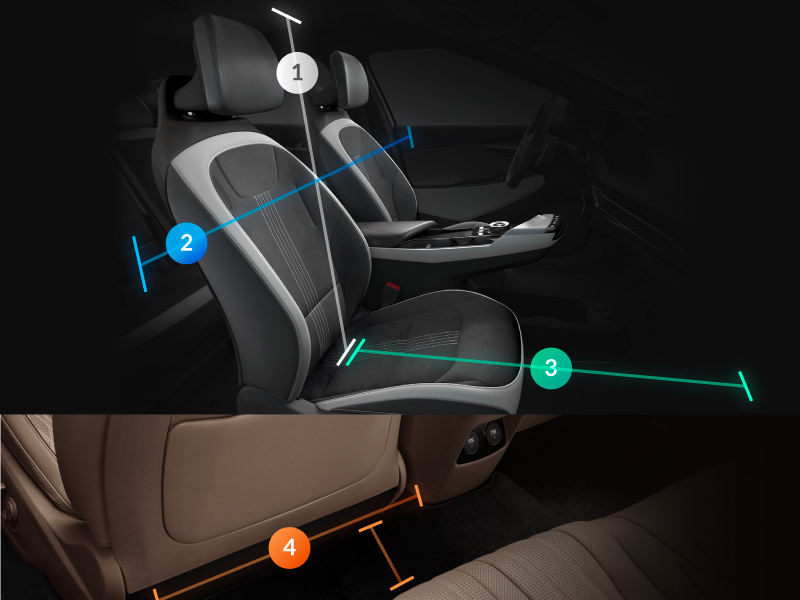
① Headroom: This dimension allows passengers to know the size of the overhead space while seated in the cabin. Head room is indicated by measuring the distance from the seat's hip point to the headlining. According to the American Society of Automotive Engineers (SAE) standard, the distance from the hip point to the headlining will be added by 102 mm (4 inches). ② Shoulder room: This is the dimension that allows the passenger to check the size of the shoulder space when sitting on the seat. Measure and mark the minimum horizontal distance between the left door trim and the upper part of the right door trim (upper armrest). The passengers can estimate the size of the width and space when they actually get in the cabin. The dimension varies mainly depending on the shape of the upper part of the door trim. ③ Leg room: This is a dimension that indicates passengers' leg room, and it is considered a major dimension to measure the size of the interior space. Usually, the distance from the hip point of the seat to the point where the feet can be extended to the maximum is measured and marked. According to the American Society of Automotive Engineers (SAE) standards, the published value is measured from the hip point to the ankle plus 254 mm (10 inches). ④ Foot room: Generally, it refers to the space where passengers' feet are placed. The foot room of the rear seat is more important than the front seat. The foot room of the second row also affects the leg room because the space according to the left and right width and height is determined by the structure of the lower part of the front seat. It affects how much the foot can be stretched under the seat.
Contents List
Your search for didn't have any matches.
- · Please make sure that all words are spelled correctly.
- · Try fewer keywords or different keywords.
Minimum 2 characters required
- Please enter at least 2 characters for more accurate results.